Will the White House Order New Federal Architecture To Be Classical?

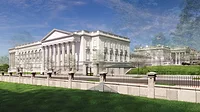
The Treasury Building is an example of Neoclassical architecture in Washington, D.C.
Photo © Sealy J via Wikimedia Commons
Editor's Note: The American Institute of Architects issued a statement in response to this story on the afternoon of February 4, 2020. Read it at the bottom of this page.
While the country was riveted by the President’s impeachment trial, a Washington rumor was quietly bubbling about a potential executive order that, if implemented, would profoundly affect the future of federal architecture.
RECORD has obtained what appears to be a preliminary draft of the order, under which the White House would require rewriting the Guiding Principles for Federal Architecture, issued in 1962, to ensure that “the classical architectural style shall be the preferred and default style” for new and upgraded federal buildings. Entitled “Making Federal Buildings Beautiful Again,” the draft order argues that the founding fathers embraced the classical models of “democratic Athens” and “republican Rome” for the capital’s early buildings because the style symbolized the new nation’s “self-governing ideals” (never mind, of course, that it was the prevailing style of the day).
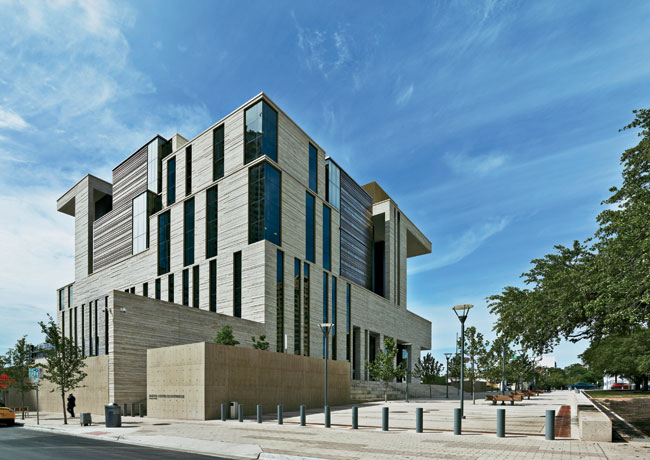
The draft decries the quality of architecture under the General Service Administration’s (GSA) Design Excellence Program for its failure to re-integrate “our national values into Federal buildings” which too often have been “influenced by Brutalism and Deconstructivism.” The draft document specifically cites the U.S. Federal Building in San Francisco (2007, by Morphosis), the U.S. Courthouse in Austin, Texas (2012, by Mack Scogin Merrill Elam Architects), and the Wilkie D. Ferguson, Jr. U.S. Courthouse in Miami (2007, by Arquitectonica) for having “little aesthetic appeal.”
The White House did not respond to a request for comment about the executive order.
Meanwhile, last week, the GSA’s Chief Architect and Director of the Design Excellence Program, David Insinga, resigned his post.
The original Guiding Principles, written by the late Senator Daniel Patrick Moynihan, mandated that Federal architecture “must provide visual testimony to the dignity, enterprise, vigor, and stability of the American government.” The draft document uses the same words—dignity, enterprise, vigor and stability—while declaring that Brutalist and Deconstructivist styles “fail to satisfy these requirements and shall not be used.”
Looking for quick answers on architecture and design topics?
Try Ask RECORD, our new smart AI search tool.
Ask RECORD →
Yet Moynihan’s Guiding Principles also dictate that “an official style must be avoided,” and that new buildings should reflect their time. “Design must flow from the architectural profession to the government and not vice versa,” the guidelines state. “The Government should be willing to pay some additional cost to avoid excessive uniformity in design of Federal buildings.”
The mechanism for the radical upending of these principles, in order to promote classical and traditional regional architecture (Spanish colonial style, for example, would be permitted in places like Florida), would be a President’s Committee for the Re-Beautification of Federal Architecture. Its members would include the Commissioner of the GSA’s Public Building Service and at least one member of the U.S. Commission of Fine Arts, designated by the President. That commission, which approves architecture and design in much of the nation’s capital, is composed of seven experts, appointed by the President to four-year terms.
President Trump’s first appointment, in November 2018, was Justin Shubow, the president of the National Civic Art Society, which is devoted to furthering classical architecture. Its website contends that “contemporary architecture is by and large a failure,” and states the organization’s mission is “to help architecture return to its pre-Modernist roots.” Much of the language in the draft document echoes the website for Shubow’s organization; it also draws heavily from an article that appeared in City Journal last summer, "Why America Needs Classical Architecture," by Catesby Leigh. Leigh is listed as the 2018-2019 research fellow of the National Civic Art Society.
Shubow became well known for his dogged opposition to the proposed Eisenhower Memorial in Washington, designed by Frank Gehry (which is finally opening this May). President Trump’s two most recent appointees to the Fine Arts Commission, made this past December, are James C. McCrery II, AIA, a founder and board member of the National Civic Art Society, and the Indiana-based architect Duncan G. Stroik, AIA, whose work is “informed by the timelessness of classical architecture and the humanism of traditional cities,” according to the Commission’s website. The terms of the four other members of the Commission expire next December.
As a real estate developer, Trump’s taste in architecture tended to the glass and steel of modernism, albeit in an often glitzy style—from the 1983 Trump Tower in New York, designed by the late Der Scutt of Poor, Swanke, Hayden & Connell, to the 2009 Trump International Hotel and Tower in Chicago, designed by Adrian Smith, then at SOM. When Trump bought the Gulf and Western building on Columbus Circle in New York in the 1990s, he hired Philip Johnson and Costas Kondylis to re-skin its facade in bronze-tinted glass, prompting the late critic Herbert Muschamp to declare it was an International Style skyscraper decked out in a gold lamé party dress.
Will an executive order to bring classical design language to new federal architecture even be issued? The White House certainly has more pressing matters on its plate. But if it happens, quietly or otherwise, the impact would be enormous.
In response to this story, the American Institute of Architects (AIA) issued the following statement:
“The AIA strongly opposes uniform style mandates for federal architecture. Architecture should be designed for the specific communities that it serves, reflecting our rich nation’s diverse places, thought, culture and climates. Architects are committed to honoring our past as well as reflecting our future progress, protecting the freedom of thought and expression that are essential to democracy.”
Looking for a reprint of this article?
From high-res PDFs to custom plaques, order your copy today!

.webp?height=200&t=1756483260&width=200 "United_States_General_Services_Administration_Building_(53843649137).jpg")